• Skip to primary navigation
  • Skip to main content

The Forum

The Forum logo
  • Home
  • Employment Resources
    • Employment Counselling
    • Employment Rights and Standards
    • Extended Drug and Health Benefits
    • Income Security
    • Returning to Work
  • Workplace Resources
    • Disclosure in the Workplace
    • Stigma and Discrimination
    • Workplace Accommodation
    • Work-Life Balance
  • Factsheets and Toolkits
  • About The Forum
Hide Search
Show Search

cnasije

Factsheet: Action Items for Consumers

cnasije · March 15, 2021 ·

Episodic Disabilities and Insurance: Action Items for Consumers

Are you a person living with HIV, MS, Arthritis, or another health condition that causes you to experience episodic disability (disability that comes and goes)? Are you eligible through your employer for health benefits and Short-Term (STD) or Long-Term Disability (LTD) Insurance?  These benefits can assist you in managing your health, but they can also be challenging to access for people with recurring and unpredictable conditions.  Here are some helpful suggestions.

Find out what is in your health benefits and STD and/or LTD plans.

Many people don’t find out what is in their plan until they need to access it. Be proactive and ask for a copy of your plan ahead of time, so you’ll be prepared and knowledgeable when you need it.

Engage with your available supports.

If you need more information or advice, ask for help from Human Resources or a similar administrative office. If you are unionized, your union representative is a good place to start with any questions you may have related to health benefits or insurance coverage.

Take a preventative approach.

Some of the things in your plan can help prevent episodes – find out what you are entitled to and use it to help you manage your episodic disability. For example, some health benefit plans allow for visits to massage therapists or mental health specialists. If you are entitled to these benefits and they would be helpful for you in managing your condition, access them.  Note, some of these services require a referral from your physician.

Provide feedback to your employer on the usefulness of the plan.

There are some insurance plan elements that can be particularly helpful for people living with episodic disabilities, as they make it easier to transition on and off claim. If you find that you are frequently moving on and off claim, you may want to talk to your employer to see if any of the following could be added to your plan:

A Recurrent Claims Clause

A recurrent claims clause allows for an individual to qualify for STD or LTD based on a reoccurrence of an established and qualified disability taking place within a specified period of time. Recurrent claims clauses are useful in that the new episode is treated as the same as the last episode and the individual is not then required to submit a new claim. There are usually time limits on these clauses; some limit the recurrence period to 6 months.

A Waiver of Elimination Period

In offering LTD, it is possible to request a Waiver of the Elimination Period. This essentially allows for an individual with a recurrent disability to qualify for support during an episode without the requirement of fulfilling a new waiting or elimination period. There are reports of elimination periods that extend for up to 5 years allowing for individuals experiencing recurrent periods of disability to immediately qualify for claim.

Remember, being prepared is an important part of self-advocacy. For more information on episodic disabilities please visit the Realize website.

Disclaimer: This fact sheet is provided for information only. Please consult with your insurance provider directly for details relevant to your unique circumstances.
Factsheet: Action Items for Employers

cnasije · March 15, 2021 ·

Episodic Disabilities and Insurance: Action Items for Employers

Are you an Employer who offers private health insurance like Short Term Disability (STD) or Long-Term Disability (LTD) as part of your employee health benefits? Do you want to improve the coverage or services you get for employees living with unpredictable and recurring episodic disabilities related to MS, Arthritis, HIV, or other health conditions?

Below are steps you can take to improve how these services support your employees:

  1. Challenge your insurer to give you some better options for managing episodic and/or chronic disabilities through STD/LTD program. Ask them to investigate options for you.
  2. Ask your insurer to give you options for those employees who require specialized medication in order to allow them to work (for example, biologics). Discuss whether the cost of the medication may be less than the employee going on STD when symptoms get unmanageable.
  3. Ask your insurer to give you more options for rehabilitation or paramedical care for those employees who live with episodic disabilities. Services such as chiropractors, naturopaths, massage therapists, osteopaths and acupuncturists can be critical to the health of employees living and working with episodic disabilities.
  4. Imposed limits of $500 per rehabilitation practitioner are hard to stick to particularly when consistent care by one practitioner is important. Instead:
    1. Ask for an option for employees to go to one practitioner to a max of $2000.
    2. Or ask for an option for employees for one practitioner to a max of $1000 at 80% reimbursement and then for anything between $1000 and $2000, a reimbursement of 60%.
    3. Or find other creative ways of problem solving.
  5. Adjust perceptions that being “away from work” is always better. Research shows that the less time spent away from the workplace, the more likely the employee will return to full time work.
  6. Ask your insurer to provide options for part-time workers to be able to access specialized drugs or specialized treatments for episodic conditions.
  7. Small businesses can ask insurers to provide options for access to “At Work Services” to assist vulnerable employees to stay at work.

Remember, there is room to tailor your plan to better meet your needs. Talk to your insurance provider today!

For more information on episodic disabilities please visit the Realize website.

Disclaimer: This Fact Sheet is provided for information purposes only. Please consult with your insurance provider directly for details relevant to the unique circumstances of your workplace.

 Copyright Realize 2017

Factsheet: Action Items for Insurers

cnasije · March 15, 2021 ·

Episodic Disabilities and Insurance: Action Items for Insurers

Are you a private health insurance provider encountering challenges related to supporting employees living and working with unpredictable and recurring episodic disabilities? Would you like to improve the affordability and efficacy of your services to this key population? Read on for action items you can take to improve services for this growing demographic:

  • Conduct internal actuarial analyses to answer the question “Are there more efficient ways to manage episodes of illness for employees living with episodic disabilities?”
  • Consider whether a specific “episodic disability leave” option that does not use the same criteria as short-term disability (STD) or long-term disability (LTD) is possible.
    • For example, could someone living and working with an episodic disability have access to 6 months of intermittent time during a period of 24 months, which would count as STD and then any time after would be treated as LTD? This would eliminate the administrative costs of opening and closing cases per episode and would activate At Work Services more quickly for employees who can stay at work during their episode.
  • Is there a different definition for “disability” that would work better when there are unpredictable periods of illness and wellness?
  • Is there a different definition for “return to work” that would make more sense for employees whose capacity can fluctuate from day to day or week to week depending on their symptoms?
  • In evaluating whether someone is totally disabled from the workplace, can the focus be on capacity as opposed to disability?
  • Engage your clients to develop more appropriate administrative processes from the perspective of employers and HR departments.
  • In order to get a better idea of the impact that STD/LTD leaves on the organization, encourage employers to implement business line reporting when implementing a STD/LTD program. This will assist in clarifying what associated costs may be.
  • For small businesses that cannot afford full STD/LTD programs, offer “At Work Services” that assist vulnerable employees who are living through an episode to stay at work or offer “Advice to Pay Services” that can be activated as needed when an episode becomes too difficult to manage at work.

For more information on episodic disabilities please visit the Realize website.

Disclaimer: This Fact Sheet is provided for information purposes only.

Copyright Realize 2017                        

Download a pdf version of this fact sheet

Factsheet: Employer Supports from Insurers

cnasije · March 15, 2021 ·

Episodic Disabilities and Insurance: What Supports Should Employers Ask for from Insurers?

Private Health Insurance is an Important Support to Employees Living and Working with Episodic Disabilities

Private health insurance is a critical benefit for employees living with episodic disabilities. How you structure your health insurance can make a big difference as to whether it will provide adequate support to your employees living with episodic disabilities. This fact sheet offers some tips on getting the most out of your private health insurance package.

What is an Episodic Disability?

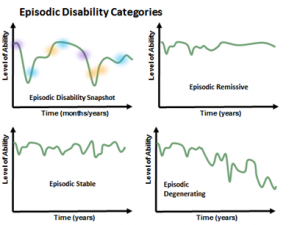
Episodic disabilities are often invisible and are, by nature, unpredictable. It can be hard for people living with episodic disabilities to fit into programs that are only view disability as a static state. Conditions that can cause episodic disability include HIV, MS, Arthritis, Diabetes, Epilepsy, mental health conditions, and others. People with episodic disabilities may also experience intermittent work capacity, and may not have made sufficient contributions to some income support programs in order to be eligible for benefits. This can make income security hard.

Offer both Long Term Disability (LTD) and Short Term Disability (STD) Insurance to Employees

For people with episodic disabilities, time away from work may be necessary in order to recover their health. STD and LTD, offered together, provide the most comprehensive coverage of income replacement. In particular, STD is important in order to cover the elimination period for accessing LTD.

Without STD, a person with an episodic disability could potentially be off work for several months (typically the elimination period is 3 months) without any income replacement of any kind. Employment Insurance Sick Benefits might address this period for some people living with episodic disabilities, however, many people with intermittent work capacity are not able to make adequate contributions in order to qualify, and there are no other publicly funded medium term income replacement programs. STD provides an important interim support to people living with episodic disabilities until they can transition onto LTD.

Some STD products can include the following provisions which would be of particular benefit to people living with episodic disabilities:

  • Opportunity to qualify for benefits when not experiencing “Total Disability”
  • Opportunity to work in a reduced capacity, with benefits

Some LTD products can include the above provisions as well.  LTD is extremely important for people living with episodic disabilities who may otherwise find themselves off work for health reasons without any other source of income.

Ask for a Recurrent Claims Clause

A recurrent claims clause allows for an individual to qualify for STD or LTD based on a reoccurrence of an established and qualified disability taking place within a specified period of time. Recurrent claims clauses are useful in that the new episode is treated as the same as the last episode and the individual is not then required to submit a new claim. There are usually time limits on these clauses; some limit the recurrence period to 6 months.

Waiver of Elimination Period

In offering LTD, it is possible to request a Waiver of the Elimination Period. This essentially allows for an individual with a recurrent disability to qualify for support during an episode without the requirement of fulfilling a new waiting or elimination period. There are reports of elimination periods that extend for up to 5 years allowing for individuals experiencing recurrent periods of disability to immediately qualify for claim. Employees and employers are encouraged to ask for a “Waiver of Elimination Period” to best support employees living with episodic disabilities.

Rehabilitation Services

Rehabilitation Services can be profoundly important in supporting an individual throughout the claims process and back to work safely. Of particular importance is the use of consistent disability case managers, who know the individual, understand their health condition as episodic and have a good understanding of the demands of their particular job. Rehabilitation services can also include specialists in Return-to-Work facilitation, Vocational Rehabilitation and Functional Rehabilitation.

Access to Specialist Advisers

Many insurance companies offer programs that include specialist advisers particularly those with expertise in mental health conditions and treatment, as part of their disability management teams. Mental illnesses are amongst those conditions considered to be episodic in nature. If possible, having access to specialist advisers who can provide insight and knowledge into the episodic nature of mental illness and other conditions is of great benefit in supporting employees with episodic disabilities.

Employee Assistance Programs (EAPs) and Wellness Promotion Programs

These types of programs are offered by insurers in conjunction with insurance products. They provide mental health and substance use support services, as well as other wellness promotion programs. These types of supports are worth investigating as they offer confidential and speedy access to specialists who may be able to assist employees living with episodic disabilities in managing issues related to living and working with an unpredictable health condition. Employees living with episodic disabilities must negotiate difficulties related to confidentiality, requesting accommodations, managing their health, stigma and disclosure. EAPs can provide timely supports for managing stress that could potentially prevent or minimize episodes of illness for employees with unpredictable health conditions, and are therefore worth investigating with an insurance provider.

Partial Permanent Disability Coverage (PPD)

This was once a more common private insurance product, but nowadays not many insurers offer PPD. For employees living with episodic disabilities, however, PPD coverage offered a number of advantages. This type of private insurance acknowledged that, for some, a disability was going to impact their ability to work full-time either permanently or for many years, but it still provided for working throughout. It did not require total disability to qualify, and in that way it offered a ‘top-up’ for individuals who were able to work at least part of the time. Many individuals living with episodic disabilities are able to work at least part of the time during illness episodes. PPD coverage provides an alternative for those individuals who are able to work somewhat during an illness episode. It is worth investigating whether or not your insurance company offers, or is willing to offer, PPD coverage, to better support employees living with episodic disabilities.

Advice to Pay Services

These services are available to companies who would like additional advice regarding whether an employee’s claim to either STD or LTD should be paid out by the employer. These are especially useful to a smaller employer who may not understand episodic conditions or that with appropriate supports and time away, valued employees with episodic disabilities can recover and return to work.

At Work Services

These services offer specialist input on how to provide accommodations to an individual worker in order to keep them at work. Ergonomic assessments and expertise in adaptive technology can comprise part of this service that can be purchased as an add-on to other insurance products or as a stand-alone insurance product.

For more information on episodic disabilities please visit the Realize website.

Disclaimer: This Fact Sheet is provided for information purposes only. Please consult with your insurance provider directly for details relevant to your unique circumstances.

Copyright Realize 2017

Download a pdf version of this fact sheet

First-Ever Virtual National Episodic Disabilities and Employment Summit

cnasije · March 13, 2021 ·

In March 2021, Realize will host the National Episodic Disabilities and Employment Summit. This event will take place entirely online over 3 days. Our goal is to raise awareness on episodic disability and employment, discuss best practices in accommodation for episodic disabilities, and develop a report on the outcomes. The event will highlight tools, research, and projects that are beneficial to both people living with episodic disabilities, and their employers.

We will take what we learn from these presentations and discussions to develop a National Action Plan on Episodic Disabilities.

This exciting event will take place over Zoom on March 23rd, 24th, and 26th from 1:00pm-3:30pm (ET) each day

Day 1 will focus on Employees and People with Lived Experience of Episodic Disability

Day 2 will focus on Employers and Accommodation Best Practices

Day 3 will include a report on COVID-19 from Employment and Social Development Canada and a facilitated discussion that will inform the development of a National Action Plan on Episodic Disabilities.

  • 7.5 CPD Hours

View the Summit Agenda here.

You can register free of charge for the summit here.

We will post summit videos and materials on the Realize YouTube channel by June 1st 2021.

Each registrant to fully attend each day will receive a Certificate of Attendance for the day/s fully attended. The Certificate of Attendance will be mailed out to attendees from May 12th 2021.

  • Go to page 1
  • Go to page 2
  • Go to page 3
  • Go to Next Page »

Quick Links

  • About The Forum
  • Contact Us
  • Terms of Use
  • Accessibility
  • Sitemap

Resources

  • Disclosure in the Workplace
  • Extended Drug and Health Benefits
  • Factsheets and Toolkits
  • Workplace Accommodation

Subscribe to Updates

Loading

The Forum by

© 2021 all rights reserved.